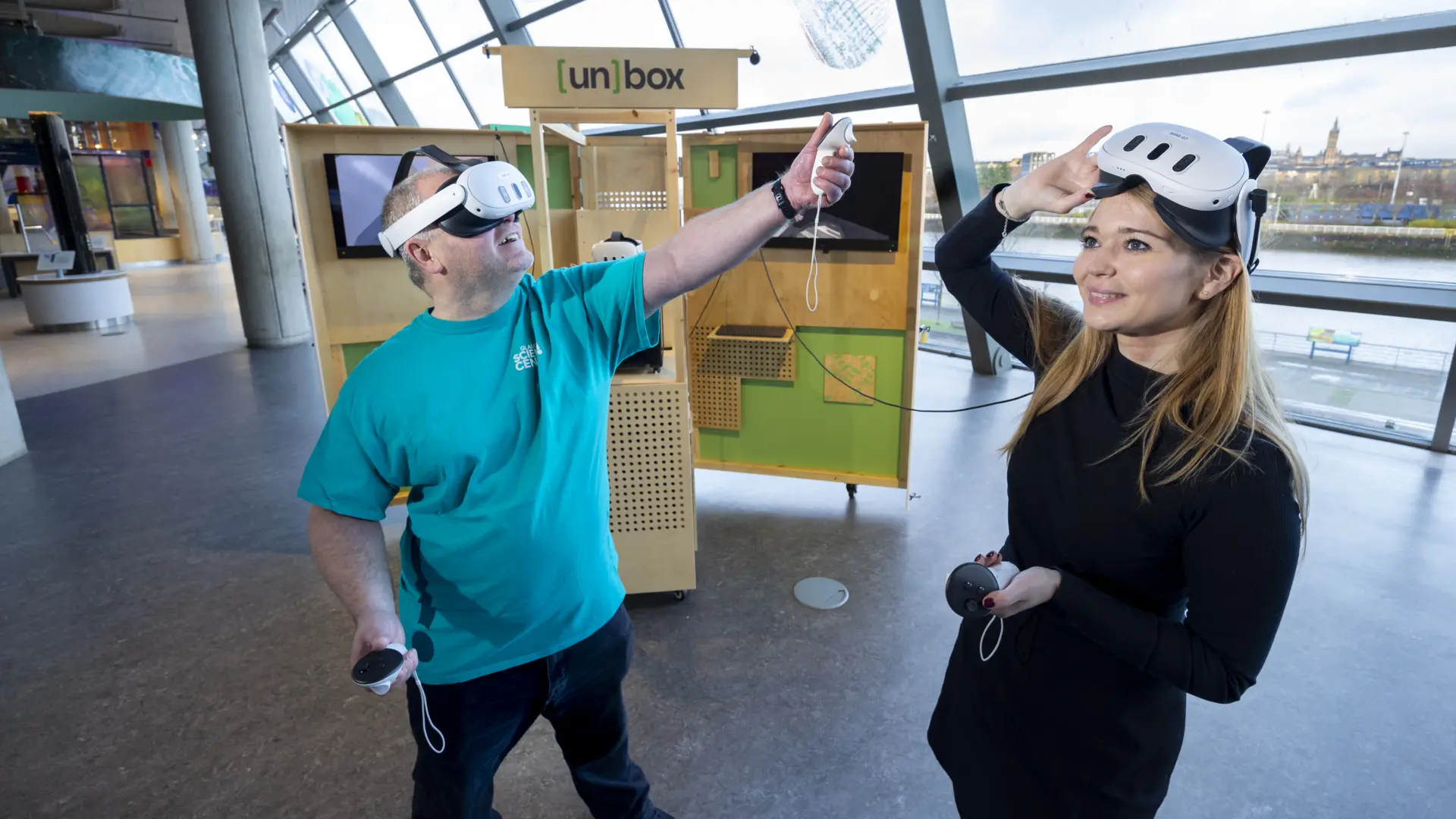
Museums in the Metaverse opens new worlds at Glasgow Science Centre
Ground-breaking virtual reality innovation developed at University of Glasgow is entertaining visitors in the heart of Glasgow Riverside Innovation District.
The University’s £6.2million Museums in the Metaverse (MiM) project has unveiled its first [un]box Virtual Reality kiosk at Glasgow Science Centre at Pacific Quay in Govan.
The kiosk showcases the project’s pioneering virtual-reality technology that allows users, through the use of a headset, to explore virtual environments and engage with incredibly accurate 3D models of Cultural Heritage collections.
Interact
The Museums in the Metaverse project is part of the Glasgow City Region Innovation Accelerator programme, funded through Innovate UK on behalf of UK Research and Innovation.
Through the ‘museum in a box’ concept, the general public will get the first chance to interact with MiM platform using the un[box], ahead of the official online launch due to take place in the coming months.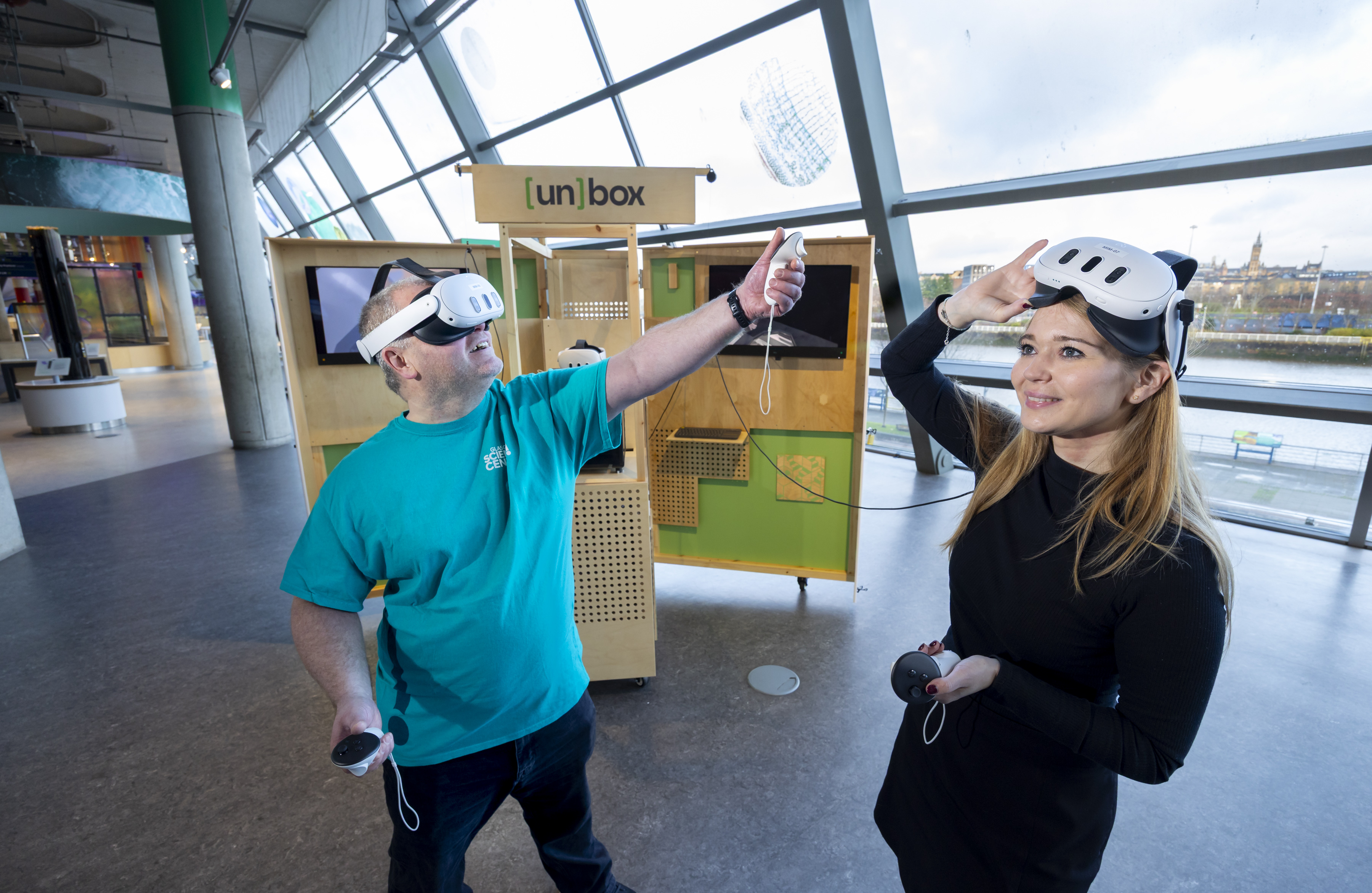
- Dr Lynn Verschuren of the University of Glasgow’s Museums in the Metaverse team and Derek Shirlaw of the Glasgow Science Centre with the un[box] VR kiosk. Credit Martin Shields
Professor Neil McDonnell, principal investigator of the Museums in the Metaverse (MiM) project, said: “It's wonderful to see the Museums in the Metaverse in the wild, not just as a concept in development but as a living experience people can step into and enjoy.
“The reaction from the public has already been extremely positive, with visitors amazed at being able to examine in Virtual Reality artefacts like Dolly the Sheep’s skull or rare fossils. This is just the beginning we have so much more to show as MiM begins to roll out nationally, opening up hundreds of digitised objects and immersive environments to audiences around the world.”
The first [un]box has now opened at Glasgow Science Centre for two weeks until 19 December 2025, to allow the public to engage with the MiM VR platform at a major visitor attraction in the city. While there, young people over 10 and adults of all ages can use the kiosk to visit a space station and examine incredibly accurate 3D models of precious natural history artefacts, including the skull of ‘Dolly the Sheep’ from the National Museums of Scotland and rare fossils and minerals.
Dr Gillian Lang, Director of Experience Development at Glasgow Science Centre, said: “We are thrilled to be able to give Glasgow Science Centre visitors the first opportunity in a visitor attraction environment to experience this ground-breaking immersive virtual environment. The collaboration with Museums in the Metaverse highlights the exciting and continuing potential of Scottish innovation and enhances interaction with the scientific culture that is woven into Scotland's heritage.”
The [un]box kiosk marks a major milestone for Museums in the Metaverse, a University of Glasgow initiative using immersive technology to unlock the potential of Virtual Reality for the cultural heritage sector and its audiences.
It's wonderful to see the Museums in the Metaverse in the wild, not just as a concept in development but as a living experience people can step into and enjoy.
Professor Neil McDonnell
Museums have long faced a fundamental challenge: globally less than 10% of museum collections are typically on public display at any one time. Furthermore, not everyone is able to access heritage sites and collections in person. This could be due to geographical constraints or health considerations, for example.
The project is addressing this by creating 3D models of rare and precious objects that can be experienced in entirely new ways. Using VR kiosks and online platforms, visitors can walk through virtual museums or build their own exhibitions using digitised objects from some of Scotland’s most important collections.
So far, MiM has digitised nearly 450 objects in partnership with the University of Glasgow’s Hunterian Museum and National Museums Scotland, and created 15 virtual environments, including the Victorian lab curated for Lord Kelvin’s bicentenary.
At the un[box] kiosk visitors to the Glasgow Science Centre can explore pre-curated virtual museums. Once MiM is fully operational users will also be able to become curators themselves designing their own exhibitions from the growing collection of digital artefacts.
The technological foundation of MiM involves hundreds of photographs stitched together through photogrammetry and enhanced by skilled digital artists to create museum-quality 3D models.
Phase One of MiM launched in 2023 with £5.6 million support from the UK Government’s Innovation Accelerator programme.
Platform
During the first two years, MiM has developed 16 individual experiences, 3 of which will be launched publicly with the platform.
Recently the MiM team secured additional funding for Phase Two which has expanded the digital collection, refined the platform and will see MiM appearing via kiosks in museums and other visitor attractions in the coming months and years.
It is important to emphasise that MiM does not aim to replace traditional museums but rather complement them, bringing collections to life in new contexts and for new audiences. By removing physical barriers, enabling hands-on interaction with precious artefacts and empowering visitors to become curators MiM is helping reshape what museums can be in the digital age.
The Innovation Accelerator programme is investing £130 million in 26 transformative R&D projects to accelerate the growth of three high-potential innovation clusters, including the Glasgow City Region.
- Title image: Dr Lynn Verschuren of the University of Glasgow’s Museums in the Metaverse team and Derek Shirlaw of the Glasgow Science Centre with the un[box] VR kiosk. Credit Martin Shields